
Deadwood CDCR Releases
Deadwood Conservation Camp #23 is a state correctional conservation camp in Fort Jones. CDCR and CAL FIRE operate the camp, and CDCR describes its mission as training incarcerated hand crews for wildfire suppression, emergency flood control, conservation work, and local community projects. Because the camp is part of the state prison system, a release from Deadwood is not confirmed through the Siskiyou County Jail public RIMS roster.
The release may take several forms. A participant may return to a parent institution, transfer within CDCR, release to parole, discharge from a term, or move into a supervision plan. Searchers should start with a CDCR number if it is known. If only a name is known, use full name, age, and commitment-county clues from court records or a prior jail record. A Siskiyou County commitment can be housed anywhere in California, and a person housed at Deadwood may have been committed from another county.
Confirm a Deadwood Release
The correct Deadwood release search starts in state custody systems. CDCR's California Incarcerated Records and Information Search, or CIRIS, is the public search path for CDCR records. BPH sources matter when a person has a parole-suitability hearing or an eligibility date. DAPO matters when the person is released to state parole. CDCR victim services and California VINE can provide notification routes for eligible registrations.
- Search CDCR CIRIS by CDCR number when possible, or by name with age and commitment clues.
- Read any location, admission, commitment county, and BPH date fields in the CDCR result carefully.
- Check BPH hearing results if the case involves suitability review.
- Use the DAPO Northern Region directory for state parole office context after release.
- Use CDCR victim services or California VINE when notification registration is available.
- If the record began with a local arrest, compare the state result with the Siskiyou court case and any county jail transfer record.
For county jail releases, use the Siskiyou County Jail page instead. A local jail release and a Deadwood release are different record events.
Deadwood Release Date Terms
CDCR and BPH release vocabulary can be precise. An earliest possible release date is not the same as a parole eligibility date. A Board hearing date is not a final release date. A grant from BPH is a recommendation for parole that is subject to further review before it becomes final. In a Deadwood case, those distinctions matter because a camp placement does not erase the controlling CDCR sentence.
| Term | Meaning in a CDCR release search |
|---|---|
| EPRD | Earliest possible release date for a determinate sentence, after applicable time allowances. |
| MEPD | Minimum eligible parole date for life-with-possibility cases. |
| NPED, YPED, EPED | Eligibility or review dates for nonviolent, youth, or elderly parole categories. |
| BPH Grant | A suitability recommendation that still goes through required review. |
| DAPO | CDCR's Division of Adult Parole Operations, which supervises state parolees. |
CDCR also explains that Case Records staff process court documents, sentence-time calculations, detainers, parole or PRCS assignment, and required notices. Those state processes can change the date or the place where a person reports after release.
Deadwood Contact and Source
CDCR lists Deadwood Conservation Camp #23 at 17148 McAdams Creek Road in Fort Jones and gives the camp phone as (530) 468-2633. The reviewed CDCR facility page identifies CDCR and CAL FIRE as the operating agencies and describes work crews, education, rehabilitation, and local conservation projects. Facility staff may handle camp operations, but release-date calculation and discharge records belong to the state records chain.
Deadwood Conservation Camp #23
17148 McAdams Creek Road
Fort Jones, CA 96032
Phone: (530) 468-2633
Operating agencies: CDCR and CAL FIRE
The CDCR Deadwood Conservation Camp #23 page is the matching source for the facility's location, mission, and camp history.
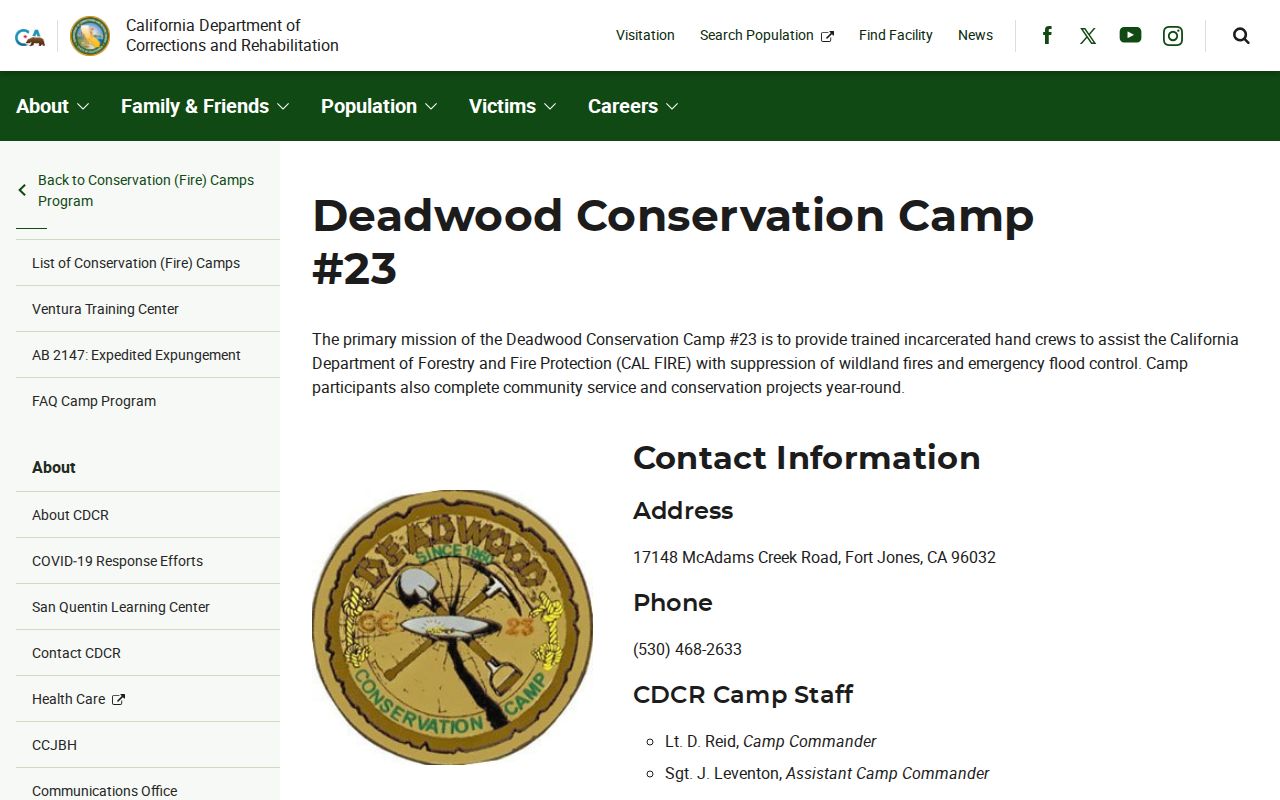
The page confirms Deadwood's state facility status, which is why a release from the camp follows CDCR rather than the county jail roster.
Deadwood Camp Release Context
Deadwood opened on June 1, 1962, and CDCR says its crews have worked on wildfire, flood-control, fuel-reduction, school, cemetery, nonprofit, community center, Castle Crags State Park, Shasta Valley Wildlife Area, and College of the Siskiyous Fire Training Center projects. That local presence can make the camp look like a county facility to readers. It is not. The release record still belongs to the state sentence and state custody system.
When a person at Deadwood has a parole or release question, search the CDCR record first, then use BPH or DAPO where the sentence requires it. The DAPO Redding parole unit is the regional state parole office identified in the research as serving Siskiyou, Shasta, Trinity, and Modoc counties. A local court case may explain the commitment, but CDCR controls the camp custody event.
Note: If a Deadwood participant was first held in the Siskiyou County Jail before state transfer, both county and CDCR records may be needed.
Deadwood BPH and DAPO Release Checks
Some CDCR release questions involve parole eligibility or parole suitability rather than a fixed release date. BPH uses date labels such as EPRD, MEPD, NPED, YPED, EPED, and controlling parole eligible date. These labels should not be collapsed into one promised release day. A parole-eligible date may create a review or hearing opportunity, while a BPH hearing result can be granted, denied, continued, cancelled, postponed, waived, or otherwise changed.
If a Deadwood participant is released to parole, DAPO is the state supervision agency. The research identifies the Redding parole unit as the rural regional office serving Siskiyou, Shasta, Trinity, and Modoc counties. That office context matters because Deadwood is physically in Siskiyou County, but parole supervision may be regional and state-run rather than handled by the county jail.
Deadwood Camp vs Siskiyou Jail
The most important distinction is custody type. The Siskiyou County Jail handles local adult jail custody and public release records through the sheriff and court. Deadwood handles CDCR conservation-camp custody. A release from Deadwood should be confirmed through CDCR's offender search, Case Records materials, BPH if the person has a hearing path, DAPO parole routing, and CDCR victim-services or VINE notification where eligible.
A person can appear in both systems over time. For example, a Siskiyou arrest can lead to a county jail booking, a court sentence, a transfer to CDCR, a camp placement, and later state parole. The county jail release record would show the local transfer, while the CDCR record would show the later state custody and release path. Treat those as linked records, not duplicates.
That sequence is why a Deadwood release check should preserve dates from each source instead of forcing them into one jail-style timeline.